Local tag libraries and data
Import and remove a library
At the bottom of the Prompt panel, open Local tag library, click Import local tag library, and choose a JSON file up to 2 MB. The explorer opens the category of the first entry. Imported tags also appear in search and suggestions. To add tags to a built-in category, use the subject and category names exactly as shown in the interface. New names create new groups.
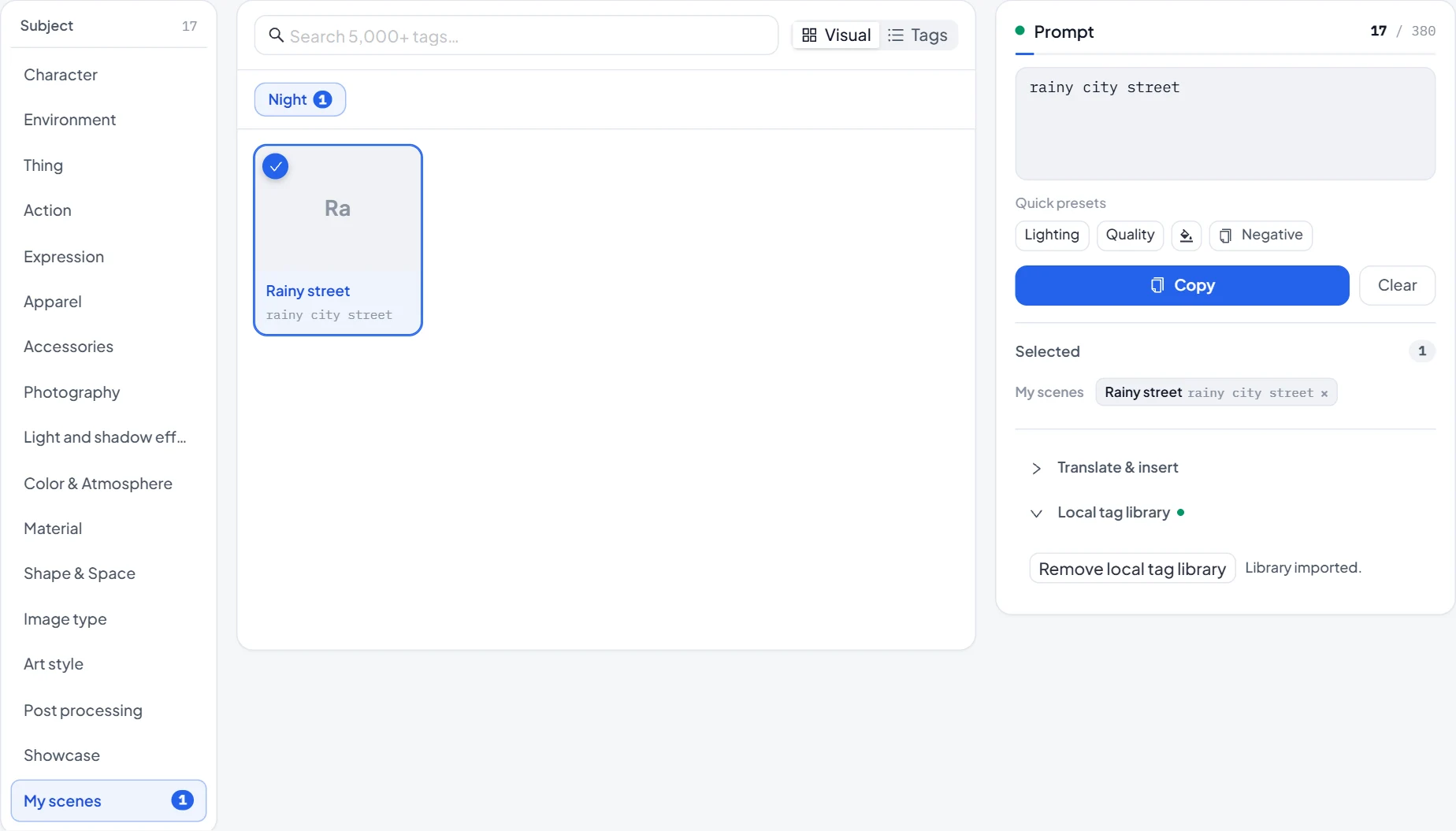
The browser reads the file locally and stores one library at a time. To replace it, click Remove local tag library and import the new file. Removing it also removes selected entries that came from that library.
JSON format
Use a nonempty array. Each entry needs object (subject), attribute (category), and displayName (text inserted into the prompt). Use langName for an optional label and description for an optional note. You can convert an existing list of terms to IMGPrompt JSON in one batch. IMGPrompt data converter
[
  {
    "object": "My scenes",
    "attribute": "Night",
    "displayName": "rainy city street",
    "langName": "Rainy street"
  }
]
Use a comma without a space inside an entry you want to keep together, like rain,neon. A comma followed by a space separates entries in the editor. Full-width commas cause imports to fail. The optional preview accepts embedded Base64 PNG, JPEG, GIF, WebP, or AVIF images. External image URLs are ignored.
Bundle tags with your build
When maintaining your own build, add tags to src/app/data/prompt-custom.json. They are published with the site and grouped by subject and category under Custom tags. The built-in multilingual library uses src/app/data/prompt/prompt-zh.json as its source.
See the entry descriptions for showcase credits. IMGPrompt source · Showcase source (CC BY 4.0)